As the holiday season approaches, it’s time to start planning your entries in the annual 3D Crosswords competitions. Both the World Championship and the RPM Trophy involve designing a 3D crossword grid and as such are a rich source of grids for future calendars. This could be your chance to get your very own puzzle design published in the 2027 3D Crossword Calendar.
Entry details for both competitions are below, along with helpful advice from the Crossword Editor. Follow the links in the Help section to get more detailed guidance on grid design and to download the templates to submit your entry.
2025 World Championship
Qualification: you must have successfully solved 12 puzzles during 2025. When you submit your monthly puzzle entry, your acknowledgement email will contain your progress status. There is also a “check your progress” link on our 2025 Puzzles Page. Solving the November Extra will give you an extra boost towards getting the required 12.
Your tasks will be:
- To create a 3D grid with a theme suitable for our 2027 calendar, or beyond. This can be an anniversary related theme appropriate to a specific month or a non-anniversary related theme which can appear in any month.
- To write a clue each for the following:
- GIFT
- INCARNATION
- SEASON OF GOODWILL
N.B. Each entrant may only submit one grid and one set of clues.
2025 RPM Trophy

There are no qualifications required for this challenge and everyone is encouraged to enter, although World Championship entrants must submit a separate grid for that competition.
Your task is to create a 3D grid with a theme suitable for our 2027 calendar, or beyond. This can be an anniversary related theme appropriate to a specific month or a non-anniversary related theme which can appear in any month. All grids submitted will be considered both for the competition and for publication.
You can submit as many grids as you wish for this competition.
Deadline
The submission deadline for both competitions is 15 January 2026.
Judging
In all aspects of each competition (clues, grids and word lists), entries will be anonymised before being sent to the judges. Make sure you only send your entries to the address specified in the word table template.
Help
N.B. The grid templates and word table files have been updated since previous years. Please ensure you download the latest versions below. Both filenames should end in “2025”.
Our 3D Grid Design Guide contains advice and tips for designing a puzzle grid.
The 3D Grid Templates (PDF) includes several varieties of cubic and dials based grids for you to use and adapt as you see fit. Or you could create your own new grid format.
The Word Table Template (.docx) is where you enter your details, the puzzle theme, and the list of words for the completed puzzle. Please return the file in the same format (i.e. Word, or we will also accept Open Office or Google Docs, but not as PDF or image please). The word table template also contains the email address for where to send your entry.
3D Exemplar Grid and Word Table (PDF) is an example of a final submission.
Advice from the Editor: How do I get my puzzle selected for publication?
If you like solving our 3D puzzles, why not have a go at designing your own? The two competitions which open this month give you the perfect opportunity. With the library of blank grids and the online guidance available, you will not have to spend hours at your dining table with pencils and rulers (been there…) and you will avoid wasting time on things which won’t work.
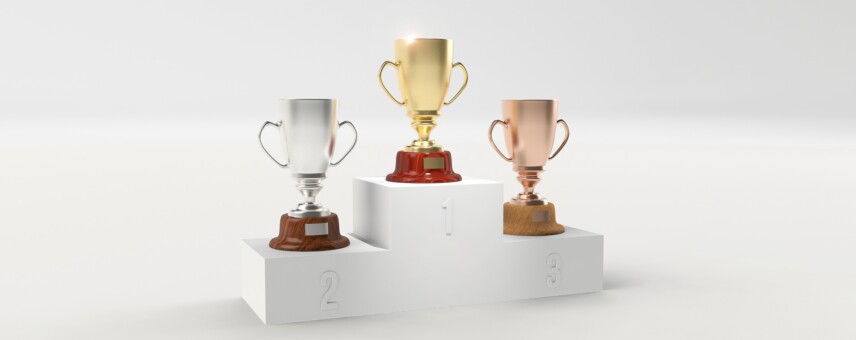
If by the end of the year you will have 12 credits from solving monthly puzzles and/or Extras, you can enter the World Championship (WC). Even if you don’t you can still enter the Ray Parry-Morris grid design competition (RPM). Each competition has a wonderful trophy designed and built by our Founder and President.
If entering the WC, you will need to compose three clues. There is plenty of advice online about clue-writing, but here I will just mention a few things.
- Be economical. Clues made up of fewer than ten words and fifty characters are usually (not always) the best. If your clue is longer, make sure it tells a coherent story.
- Make sense. A reasonable surface meaning is much more satisfying to the solver. And if your clue is witty or can mislead the solver as to what the solution must mean, so much the better.
- Obey the usual setting rules. Generally there must be either a definition of the solution which could replace it if used in a sentence without the need for additional words, or else a description of it. Elements of wordplay must not require too many steps to be taken by the solver: if using an anagram, the ‘fodder’ for the anagram must appear in your clue, and not a synonym of it. If your wordplay includes abbreviations or symbols, make sure that they appear in the Chambers dictionary.
Whether or not you have the 12 credits, you can enter the RPM. For that you will need to select a theme (usually, though not absolutely essential). Choose one of the grids from our library of templates which is suited to the subject and has word lengths which will suit the most important of your thematic entries.
Here is some useful advice on grid-filling.
Make yourself a list of entries which you consider essential, and others which you would like to include. Place the essentials in a way which will not leave too many awkward letters in awkward places. I find the most awkward letters — apart from the obvious J,Q,X,Z — tend to be I,N,O,U,V and Y. So you should avoid placements where these come at bad positions in a word. However, because our puzzles feature bi-directional entries, a final V or an initial Y can often be overcome by a change of direction.
A few obscure but dictionary-listed entries will be fine, but avoid words or proper names which will require esoteric knowledge or a long internet search to find them. Phrases must generally be things people regularly say or write in real life.
If you are including in your grid multiple examples connected to a theme, try to make sure that they can all be connected in a similar way, to help both solver and setter.
Easter Eggs (EE) — i.e. thematic entries not clued and to be found in the grid after solving the clues — can be great fun. We do like formats for this which are more original than the conventional jumbles in shaded cells: think of ways in which you can ‘hide’ items in plain sight — our grids offer many possibilities of this.
Of course, concealing the EE before you fill the grid will put constraints on your word choices. But no-one said it would be easy!
Have a good look at the grids from the last few years — all our puzzles are in the archive and many are very inventive indeed — and see if, without copying an idea wholesale, you can find inspiration for something which will be your own innovation. There are still many potential ideas out there, waiting to be discovered! And, yes, you can invent your own grid shape — but make sure it will fit on a calendar page and that it will be possible to represent it in 2D while keeping the letters visible.
What theme should you choose? You will realise that we like anniversaries, the rounder the figure the better of course; however, neither the anniversary nor the roundness is essential.
Inventions, foundations, historical turning-points, births and publications will spring to mind. But you may prefer something quirky or something not widely known. (The less well-known the commemorated event, the less likely you are to see ‘your’ discovery duplicated.)
Nor are we limited to specific dates. Every year I make a plea for unusual subjects, and I am pleased to see that designers are responding to that, and duplication may have become a thing of the past! So why not a puzzle about Mars, motor-cycling, reservoirs or rabbits?
Please do avoid the gloomy and the tendentious: social problems, environmental fears and diseases on the one hand, and political or religious partisanship on the other, may be vital issues but they will not make for a good puzzle for all solvers or be a distraction over breakfast or coffee from the darkness so much in evidence in the world.
I hope many of you will enter — without your grids, putting the Calendar together is much less fun and much more work — and I wish you luck in the competitions.
AGC